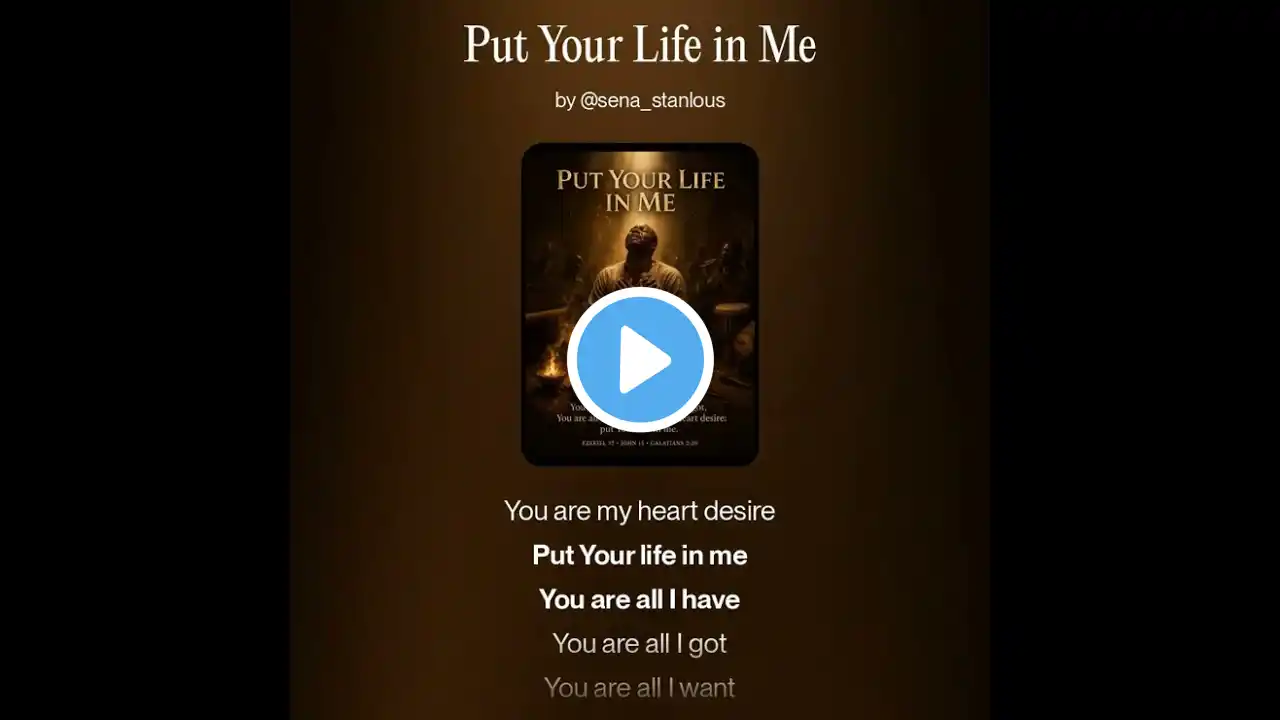
Put Your Life in Me
Put Your Life in Me is a deep cry for the breath, life, and indwelling presence of Yahuah to fill mortal man again. It draws from Genesis (Bere’shiyth) 2:7, Ezekiel (Yechezq’el) 37, John (Yochanon) 7:37–39, John (Yochanon) 15, Jeremiah (Yirmeyahu) 31:33, Romans (Romaiym) 8:11, and the longing that the inward man be made alive by the Ruach of Elohiym. This is not merely a song about comfort. It is a plea for resurrection, renewal, fruitfulness, and total surrender. “Breathe on these bones again, breathe on this dust again” reaches straight into Ezekiel (Yechezq’el) 37:1–10, where breath entered dry bones and they lived, and into Genesis (Bere’shiyth) 2:7, where Elohiym formed man from dust and breathed into him the breath of life. The lyric is saying, 'I am not self-sustaining; if You do not breathe, I remain dust.' “Breathe on this heart again; put Your life in me” turns that same cry inward. Let the seat of desire, will, memory, and affection be visited by divine life again. “I am but dust and clay, I fade like grass away” confesses human frailty, as seen in Psalm (Tehilliym) 103:14–16. “My flesh has lost its strength” admits that human power cannot restore itself. “I thirst in desert lands, I lift my empty hands” expresses the condition of the soul apart from His filling: dry, needy, unable to sustain itself. “Let Ruach fill this frame” asks that the body itself become a vessel of divine life. “Quicken this mortal frame, quicken this inward man, quicken this longing heart” reflects Romans (Romaiym) 8:11, where the Ruach gives life even to the mortal body and also the scriptural distinction between outward weakness and inward renewal. “Let living waters rise, break open shut up sides, flow out from deep within” points to John (Yochanon) 7:38, where out of the belly shall flow rivers of living water. The song is not asking only to survive but to become a vessel from which life can flow. “Write Torah on my heart, tear every veil apart, cause me to walk Your ways” joins Jeremiah (Yirmeyahu) 31:33 with the promise of inward obedience in Ezekiel (Yechezq’el) 36:26–27. The singer is asking not for shallow emotion, but for covenant transformation. The Torah must move from stone to heart; the veil must be torn away; the walk must change. “You are all I have, You are all I got, You are all I want, You are my heart desire” is one of the tenderest parts of the song. It is total dependence and total affection. This is the language of one who has reached the end of self-sufficiency and is saying that Yahuah alone is portion, help, and desire. “Abide in me, O Vine, and let Your fruit be mine, for cut off, I am dry” draws directly from John (Yochanon) 15:4–5. Apart from Ha'Mashiach, there is dryness; in abiding, there is life and fruit. “Be in me as the light, and drive away the night; shine through this earthen tent” speaks of the treasure in earthen vessels and the light of Elohiym shining through human weakness. “Let mind of Ha’Mashiach be formed in inward parts, till self is seen no more” points toward the inward formation of the nature and mind of Ha’Mashiach, a surrender so deep that self-rule is displaced by His life. “Breathe, O Ruach, breathe, on the slain, on the dry, on the low, on the weak—awake” echoes Ezekiel (Yechezq’el) 37 again, but now it widens the cry to every broken and emptied place. The slain, the dry, the low, and the weak are not beyond reach. “Awake, O inward man… fill this house again” shows that the true house needing visitation is the inner life of man, though it can also extend to the gathered assembly. This is a cry for renewed habitation. “Not my will, but Yours. Not my breath, but Yours. Not my name, but Yours. Not my strength, but Yours. Not my fire, but Yours. Not my way, but Yours” is the closing surrender of the song. It moves from asking for life to yielding ownership. The breath requested is no longer for self-exaltation but for belonging, obedience, and the life of Yahuah to be manifested. Dust is not too low for Yah to breathe upon, dryness is not too deep for living waters to rise through, and weakness is not too final for the Ruach to quicken. This song tells the listener that true life is not self-made; it is received. The inward man can awaken again. The mortal frame can be quickened. The dry branch can live by abiding in the Vine. The thirsty heart can become a fountain. And the one who has nothing left can still say with confidence: if He puts His life in me, I will live. This is the sound of surrender, dependence, and holy longing for the very life of Yahuah to fill the whole man.