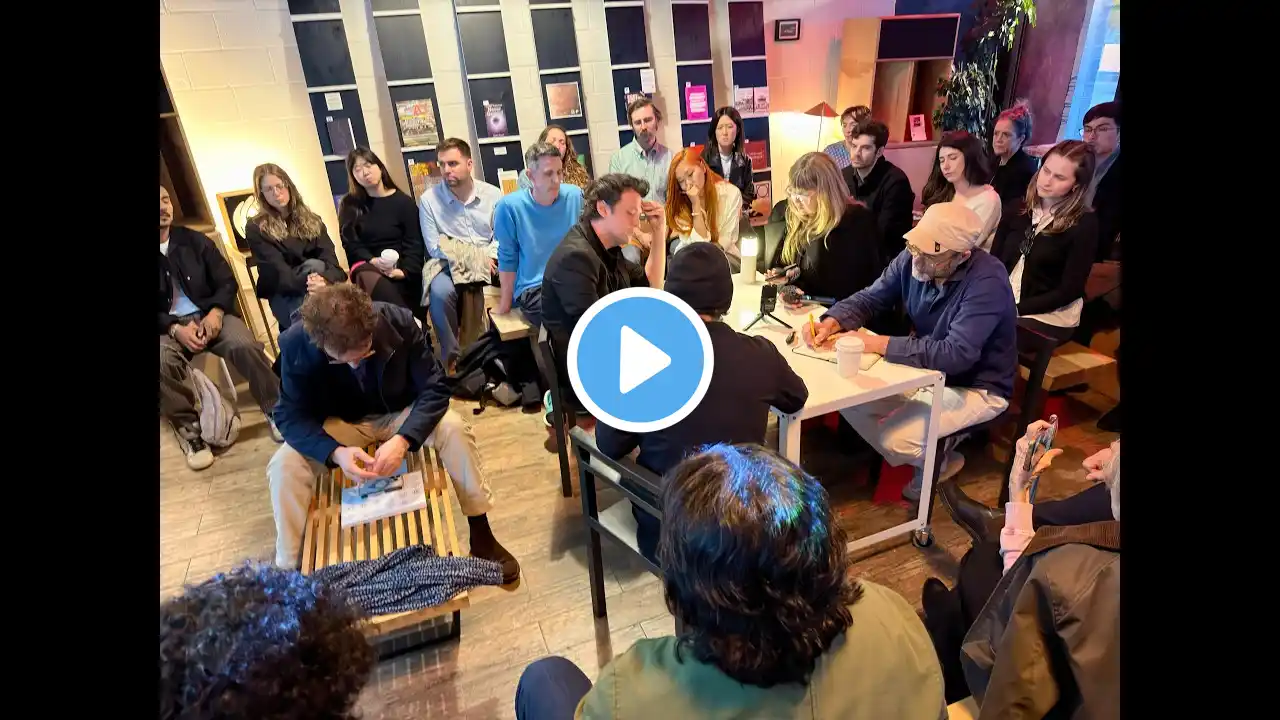
Material AI – Book Talk
Material and Artificial Intelligence in Architecture Book launch and discussion at Head Hi Brooklyn, New York April 28, 2026 Jonas Coersmeier in discussion with Ed Keller Gökhan Kodalak Danielle Willems and closing reflections by Sanford Kwinter #MaterialAI --- Material AI Conversations about AI unfold at a moment of material and ecological destabilization. Though often framed as immaterial or abstract, AI is itself materially entangled in these systems, and in their destabilization. This work advances a material argument about AI: not as abstract intelligence, but as material intelligence. Cognition — including the artificial kind — does not float above matter. It is inseparable from material processes. The argument is developed through three domains of architecture: theory, technology, and design. First, theory: Much of modern thought operates through dualities — mind and matter, nature and culture, human and machine — what Donna Haraway calls “the maze of dualisms through which we explain the world and our bodies to ourselves.” The ecological crisis emerged from us imagining ourselves as outside the systems we inhabit, or what we call nature. If we now position AI as tool, threat, captor, or savior, we risk reproducing that same structure. A material perspective refuses the idea that intelligence floats above matter. It treats cognition as emerging through entanglement, distributed across bodies, environments, infrastructures, and technical objects. Second, technology: Classical computation was symbolic and binary. It modeled itself on language. It rendered reality into binary structures and deterministic trees. Much of late-20th-century thinking reinforced this, through the hardware/software split — the idea that intelligence is abstractable from its substrate. That separation cannot be sustained. Intelligence is always already embodied. Contemporary AI systems operate differently. They are probabilistic in nature, navigate latent spaces, and require sources of randomness. In most current systems, including diffusion models, the noise driving these processes is generated algorithmically through pseudo-randomness. Yet genuine randomness ultimately derives from physical processes, and emerging AI developments increasingly turn to material itself as a source of entropy. In quantum computation, the bit is no longer simply on or off — the Qubit fluctuates. At the computational base, abstraction and substrate are no longer cleanly separable. The production of intelligence here becomes inseparable from the dynamism of matter itself. Third, design: Architecture is constituted through the convergence of theory, technology, and design. These domains are often separated and treated in isolation. In our studios, we work toward re-entangling them. Design unfolds as a material–discursive practice, where matter and meaning, thinking and making, are inseparable. Within this, AI systems, robotic fabrication, and physical material experiments are entangled in feedback loops: .Material responses inform computation. .Computation informs fabrication. .Fabrication re-enters material. The idea of embodied intelligence is not new. Alan Turing already imagined a machine that learns like a child — through sensory engagement with the world. What interests me is not the fantasy of autonomous abstract minds, but the possibility of machinic material intelligence — systems that designers collaborate with and are shaped by as much as they shape them. Put briefly: In a climate oscillating between existential fear and naive optimism, we need another plane of engagement. Not outside. Not above. But within. [..] Design Ontology As we work with these themes of material reality, we encounter fundamental questions about the nature of design itself: How do things come into being, form, and individuate? What role do we, as architects, play in this process? Do we act as planners and constructors, imposing form upon passive matter, or as gardeners, seeding, nurturing, and guiding the emergence of structure and form? Do we use tools and devices to author and shape, or do we collaborate with and afford design intelligence to machine and material? [..] Shared Materiality In a cultural climate where AI evokes either existential fear or techno-utopian expectation, a position rooted in Shared Materiality offers an alternative—not a middle ground, but a new plane of engagement. Rather than framing AI as either captor or savior of humanity, Shared Materiality positions it as an active participant in a reality not solely centered on human concerns. [..] Cobalt Passage An Anecdote from the Perspective of an Atom Imagine, if you will, cobalt embedded within the Earth's mineral currents, shifting with pressures and heat, transforming through deep geological time. Billions of years ago, I was forged in the explosion of a dying star, [..] --- video recording by Thea Nontavatit


