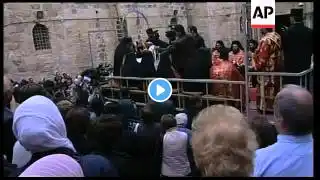
Holy Footwashing Ceremony at the Church of the Resurrection Jerusalem-Orthodox Easter–Great Thursday
An important and personal request from me (followed by information about the Great Thursday (Maundy Thursday): unfortunately as a tour guide I have not worked since February 2020. Please subscribe to my site and let me show you the Holy Land through it On my YouTube site, you can watch more than 19,000 videos about Israel and the Holy Land I would be happy if you could share the site with your other friends who are interested in the rich and sacred history of the place Thanks Zahi Shaked / zahishakedisraelitourguide / zahi_shaked_israeli_tour_guide The holy foot washing ceremony in the Orthodox Church is observed on Holy and Great Thursday (Maundy Thursday). The holy service of foot washing is a piouis ceremony normally performed by a Metropolitan Bishop or an Abbot in Eastern Orthodox Churches. During the service Bishop washes the feet of twelve priests and the abbot performs the ceremony with twelve members of his brotherhood in his monastery. This ceremony occurs towards the end of the Divine Liturgy. Immediately following Holy Communion, the priest or the brotherhood member’s willl move in a procession to the spot where the ceremony will take place, usually in the center of the nave, in the narthex, or a location outside. Psalms, hymns, litany are recited and the prayer is read by the bishop or abbot. St Johns chapter is then read. The deacon reads from St. Johns but stops where the dialogue between Jesus and Peter begins. Senior ranking clergy will speak the words of St Peter whereas then words of Jesus Christ will be spoken by the Bishop or Abbot. They will then conclude with reading prayers from the Gospels. Water used for the ceremony is sprinkled on all those who are present for the occasion. The procession then returns to the church for the final dismissal. Similar to the Eastern Orthodox Churces, the Oriental Orthodox Churches conduct foot washing ceremony on Holy Thursday. It shall be noted that in the Coptic Orthodox church the ceremony is performed by the parish Priest who blesses the foot washing water with a cross and washes the feet of the entire congregation. On Holy Thursday the Armenian Church celebrates the Divine Liturgy. The washing of the feet is known by the name ‘Vodunluvah’ and the long vigil service known as Khavaroom is also conducted. Normally the ceremony is held in the late afternoon. The service was actually written by St Ephrem the Syrian, who was one of the greatest Orthodox Church Fathers of all time and was later translated into Armenian. The Armenian Church engages in the holy ceremony with much reverence anreminding the faithful of how Christ washed the feet of His apostles. The priest washes the feet of twelve church members, usually young men are chosen for this. In Syrian and Indian Orthodox Churches the foot washing ceremony is performed only by Bishops. Twelve people, including laymen and priest are elected for the ceremony. The Bishop will wash and kiss their feet and it is performed in between reading of the scriptures followed by the washing of the Bishops feet by the eldest Priest. The ceremony concludes with prayers. The ceremony of foot washing is very important tradition and not merely a reenactment of a Biblical event and holds much significance and spiritual meaning. Those participating in the ceremony will wash and clean themselves from their sins. Zahi Shaked A tour guide in Israel and his camera [email protected] +972-54-6905522 tel סיור עם מורה הדרך ומדריך הטיולים צחי שקד 0546905522 My name is Zahi Shaked In 2000 I became a registered licensed tourist guide. My dedication in life is to pass on the ancient history of the Holy Land. Following upon many years of travel around the world, which was highlighted by a very exciting emotional and soul-searching meeting with the Dalai Lama, I realized that I had a mission. To pass on the history of the Holy Land, its religions, and in particular, the birth and development of Christianity. In order to fulfill this "calling" in the best way possible, I studied in depth, visited, and personally experienced each and every important site of the ancient Christians. I studied for and received my first bachelors degree in the ancient history of the Holy Land, and am presently completing my studies for my second degree.(Masters)