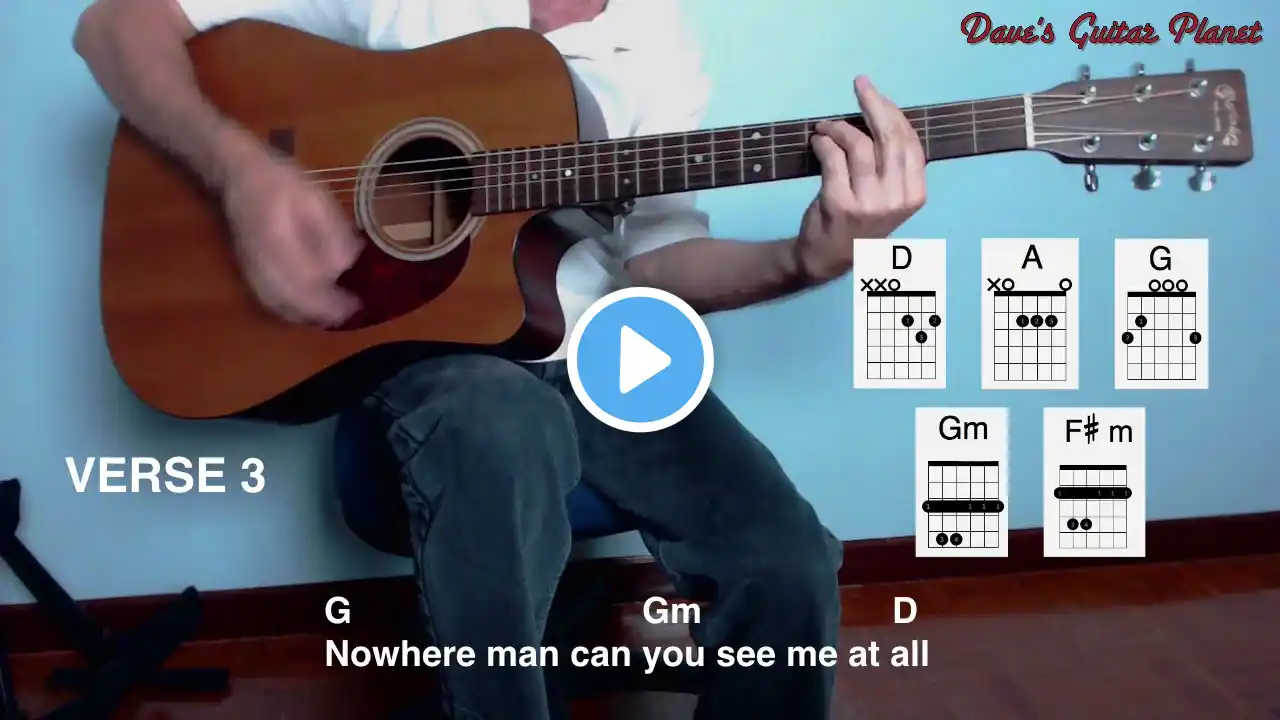
The Beatles - Nowhere Man - Guitar Cover
A fantastic track from the Rubber Soul album! “Nowhere Man” features a beginner-friendly acoustic rhythm guitar part, well-crafted lead guitar lines, and a famous dual guitar solo by John and George. Note that the final recording is slightly flat. Support the channel: Patreon: / mattiboo Paypal: https://www.paypal.com/donate/?hosted... The base track for “Nowhere Man” was recorded with John playing rhythm guitar, George apparently sitting out for this session. Later that day, lead guitar overdubs were added. All lead guitar parts are double tracked (sometimes only one video is shown in my cover when the double tracking is exactly the same). The recording of the guitar solo has been recounted in interview with George Harrison: John and George plugged their matching Sonic Blue Fender Stratocasters into separate Vox amplifiers and recorded through a single microphone placed between the amps. Paul McCartney, in the forward to “The Beatles Recording Sessions” explains that the solo guitar part was run through multiple EQ units to boost the treble. Listening to the released track appears to confirm this; the solo is bright and jangly with notable clipping, perhaps due to overloading one of the analogue EQ/mixing units at Abbey Road. Since The Beatles signal chain was purely analogue, this clipping is not terribly harsh. However, it does not appear that this bold equalization was applied to the lead guitar parts throughout the rest of the song - they sound much mellower. It is my belief that the lead guitar parts were recorded using the middle pickup, not the treble pickup as many other cover artists use. The treble pickup’s sound is much harsher and biting on the Stratocaster, whereas the middle pickup provides a rounder, fuller sound. Once strong treble EQ is applied, like the original, the final result is a full sound with strong treble presence. The non-EQed lead guitar parts also sound closer using the middle pickup to me. However, due to differences in the signal chain and other factors, I cannot say with certainty which pickup was used on the original recording. The other short lead guitar phrases throughout the song are also subject to some mystery. While it is well documented that the solo was played by both George and John in unison, the same cannot be said about the other lead guitar parts. The authors of “Recording The Beatles” documented instances of “internal bouncing” during 1965, whereby two tracks would be combined onto one. This suggests that the lead guitar parts did not necessarily need to be played simultaneously, George could have double tracked the lead guitar parts himself, then had the tracks bounced onto the final Track 2 of the master tape. However, due to tracking logistics it seems most likely that the lead guitar was played simultaneously by John and George - see the discussion in the comments. The lead segments are played very tightly; the same tightness cannot be said about the guitar solo - more on that next. The guitar solo (0:39) loosely follows the vocal melody. It sounds to me as if one guitar part is slightly louder than the other, perhaps due to the single microphone placement between the Vox amps. I believe this louder guitar was George’s due to a few factors. The July 1, 1966 Budokan performance of “Nowhere Man” clearly shows George playing the solo (very clear!). He is careful about playing the melody notes, as evidenced by sliding up to the B note at 0:46 and individually playing the notes of the F#m chord. Likewise, he plays the final harmonic note while John does not. This precision can be heard in the slightly louder solo part. The second guitar part, which is slightly quieter in the mix, is looser about playing the melody notes, instead strumming two other notes of the chord. I believe this part was played by John. The other lead guitar phrases have notable attributes as well. It should be addressed that while some believe these parts were played with a capo on the 2nd fret, I do not. While the same notes can be played with the capo and without, the doubled B note sound at 0:20 indicates no capo was used. Perhaps more so than the solo, one of the double tracked lead parts sounds louder than the other. At 0:06, the lead guitar plays a curiously voiced E9 chord before falling into the usual descending guitar tag. The next two descending tags (0:20, 1:07) feature a doubled B note. The remaining tags play an isolated B note. At 1:25, the lead guitar lightly hits a B power chord before finishing on E and B notes. At the corresponding point in the bridge at 1:55, the B power chord comes in slightly earlier, with one of the lead parts strumming more of the B chord. The ending at 2:13 lead guitar plays single notes. Description continued in pinned comment! Instruments Used: Rhythm Guitar: Gibson J-160E Standard Lead Guitar: Fender Sonic Blue Classic Player ‘60s Stratocaster Amp: Vox AC15C1