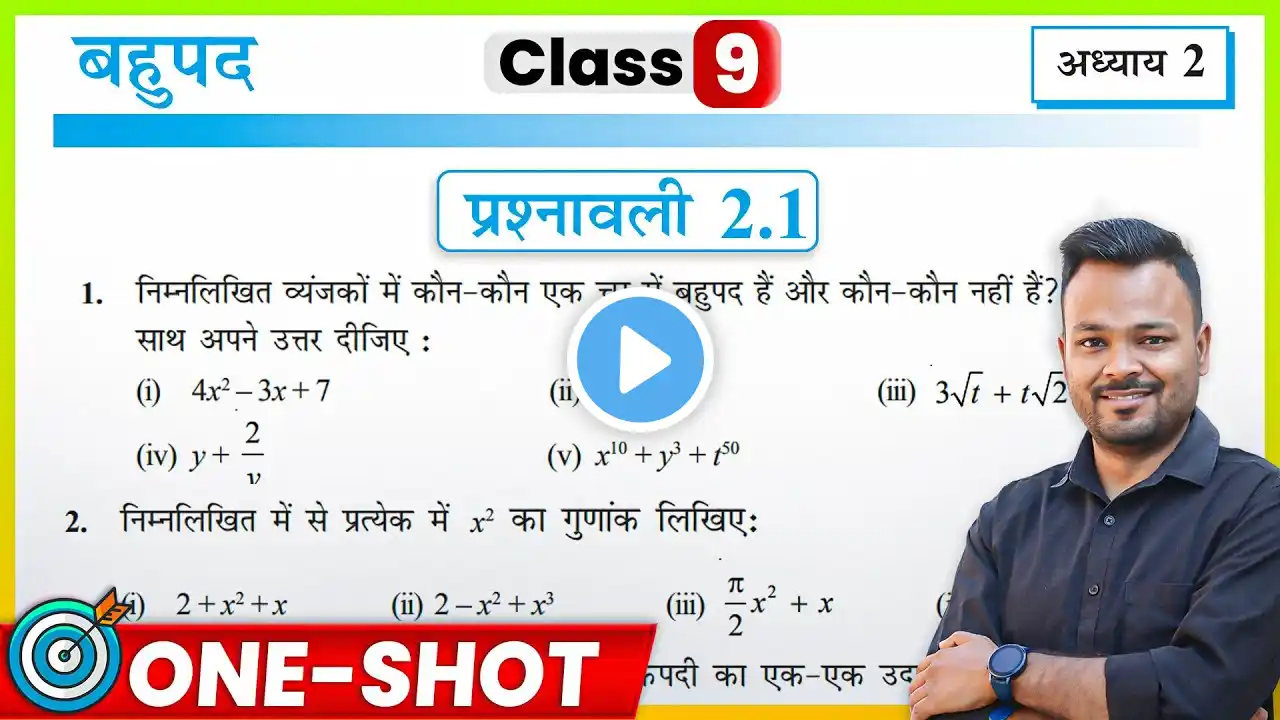
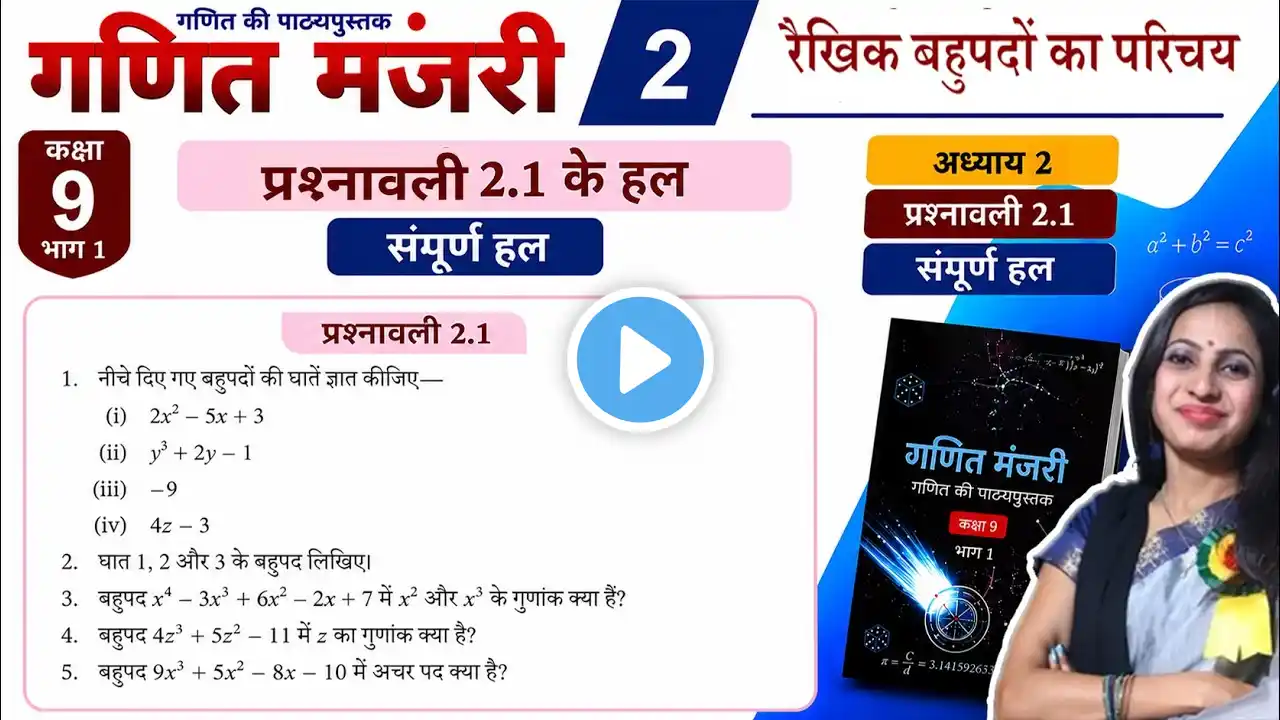
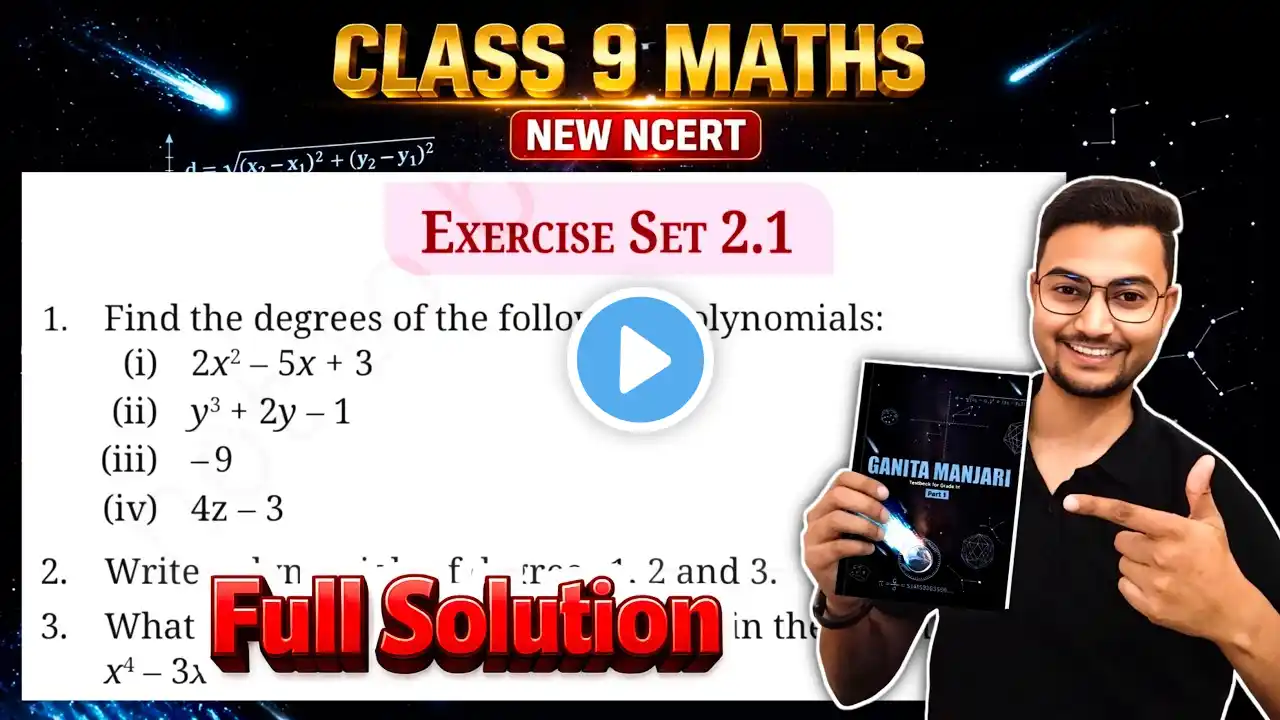
Class 9 Maths Chapter 2 NCERT in Hindi | Exercise 2.1 | RBSE | Exercise 2.1 |
class 9 maths chapter 2 ncert in hindi | Introduction | RBSE | Ch 2 Polynomial | Click here for notes 👇👇👇👇 https://civilcourtpractisetcbhati.blo... Join Telegram to join 👇👇👇👇 https://telegram.me/vinayclassesofficial Click here for the playlist 👇👇👇 • Playlist There are two types of quantities in algebra: (i) Variable quantity (ii) Constant quantity Constant quantity - Quantities whose values are fixed are called constant quantities, such as 3, 0.2, All real numbers like 3/5, √2, etc. are constants. Variables - Quantities whose values are not fixed are called variable quantities. Such quantities are written with lowercase letters of the English alphabet, such as x, y, z, etc. Algebraic Expressions - Expressions formed using variables, constants, and operations are called algebraic expressions, such as 2x + 5, y² - 6x + 7, etc. In algebraic expressions, terms are formed using the (+) and (-) operations, while factors are formed using the (×) and (÷) operations. When a term is factored, the numerical factor obtained is called the coefficient of the remaining term, such as: 3x² + 5xy + 7 Coefficient of x² = 3 Coefficient of xy = 5 Coefficient of constant term = 7 Polynomial - Any algebraic expression with one or more terms is called a polynomial in which the degree of the variable is a whole number, such as: y³ + 3, 3x² + 5xy + 7 A polynomial that does not contain a variable is called a constant polynomial, such as: constant polynomial = 5 The zero of a constant polynomial is called a zero polynomial. If a polynomial contains the variable x, we can express it as P(x), such as: P(x) = x² + 5x - 3 P(y) = y³ + 5y² - y - 3 The exponent of the term containing the highest degree of the variable in a polynomial is called the degree of the polynomial. Polynomials of degree one are called linear polynomials, such as -2x + 3, √2y + 3. Polynomials of degree two are called quadratic polynomials, such as x² - 9, y² + 8y + 15. Polynomials of degree three are called triple polynomials, such as x² + 2x² + 5x + 3. Zeros of a Polynomial If a real number replaces the variable in a polynomial and the value of the polynomial becomes zero, then that real number is called the zero of that polynomial. For example, 3 and -3 are the two zeros of P(x) = x² - 9. Remainder Theorem - Suppose P(x) is a polynomial of degree one or more. If P(x) is divided by the linear polynomial x - a, the remainder is P(a), where a is a real number. Factor Theorem - If P(x) is a polynomial of degree one or more and a is any real number, then - (i) (x-a) is called a factor of P(x) if P(a) = 0. (ii) P(a) = 0 if x-a is a factor of P(x). 00:00 intro 00:05 Question 1 07:47 Question 2 10:42 Question 3 Give an example of a binomial of 35 degrees and a term of 100 degrees. 11:54 Question 4 13:56 Question 5