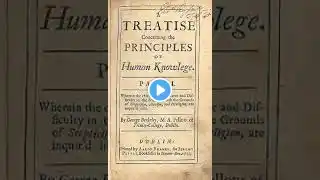
Treatise Concerning the Principles of Human Knowledge | Wikipedia audio article
This is an audio version of the Wikipedia Article: https://en.wikipedia.org/wiki/A_Treat... 00:01:19 1 Content 00:01:28 1.1 Introduction 00:03:08 2 Part I (Note: Part II was never published) 00:03:21 2.1 "To be" means "to be perceived" 00:06:03 2.2 Locke's primary and secondary qualities 00:07:31 2.3 Number 00:08:05 2.4 Sensed qualities are mental 00:09:48 2.5 Meaning of imaterial substance/i 00:10:49 2.6 Knowledge of external objects 00:12:30 2.7 Berkeley's challenge 00:13:58 2.8 Absolute existence 00:14:26 2.9 What causes ideas? 00:16:29 2.10 Natural laws 00:17:35 2.11 Strong and faint ideas 00:18:27 2.12 13 Objections to Berkeley's principles 00:18:38 2.12.1 Objection 1 00:20:02 2.12.2 Objection 2 00:20:37 2.12.3 Objection 3 00:21:22 2.12.4 Objection 4 00:22:22 2.12.5 Objection 5 00:23:12 2.12.6 Objection 6 00:23:55 2.12.7 Objection 7 00:24:34 2.12.8 Objection 8 00:25:15 2.12.9 Objection 9 00:26:06 2.12.10 Objection 10 00:26:57 2.12.11 Objection 11 00:28:02 2.12.12 Objection 12 00:28:35 2.12.13 Objection 13 00:29:23 2.13 Consequences 00:29:38 2.13.1 Banished questions 00:30:08 2.13.2 We can know only ideas and spirits 00:30:28 2.13.3 Ideas, or unthinking things 00:36:46 2.13.4 Spirits, or thinking things 00:39:02 2.14 Main purpose 00:39:59 3 See also Listening is a more natural way of learning, when compared to reading. Written language only began at around 3200 BC, but spoken language has existed long ago. Learning by listening is a great way to: increases imagination and understanding improves your listening skills improves your own spoken accent learn while on the move reduce eye strain Now learn the vast amount of general knowledge available on Wikipedia through audio (audio article). You could even learn subconsciously by playing the audio while you are sleeping! If you are planning to listen a lot, you could try using a bone conduction headphone, or a standard speaker instead of an earphone. Listen on Google Assistant through Extra Audio: https://assistant.google.com/services... Other Wikipedia audio articles at: https://www.youtube.com/results?searc... Upload your own Wikipedia articles through: https://github.com/nodef/wikipedia-tts Speaking Rate: 0.753187951148912 Voice name: en-US-Wavenet-F "I cannot teach anybody anything, I can only make them think." Socrates SUMMARY ======= A Treatise Concerning the Principles of Human Knowledge (commonly called Treatise when referring to Berkeley's works) is a 1710 work, in English, by Irish Empiricist philosopher George Berkeley. This book largely seeks to refute the claims made by Berkeley's contemporary John Locke about the nature of human perception. Whilst, like all the Empiricist philosophers, both Locke and Berkeley agreed that we are having experiences, regardless of whether material objects exist, Berkeley sought to prove that the outside world (the world which causes the ideas one has within one's mind) is also composed solely of ideas. Berkeley did this by suggesting that "Ideas can only resemble Ideas" - the mental ideas that we possess can only resemble other ideas (not material objects) and thus the external world consists not of physical form, but rather of ideas. This world is (or, at least, was) given logic and regularity by some other force, which Berkeley concludes is God.


