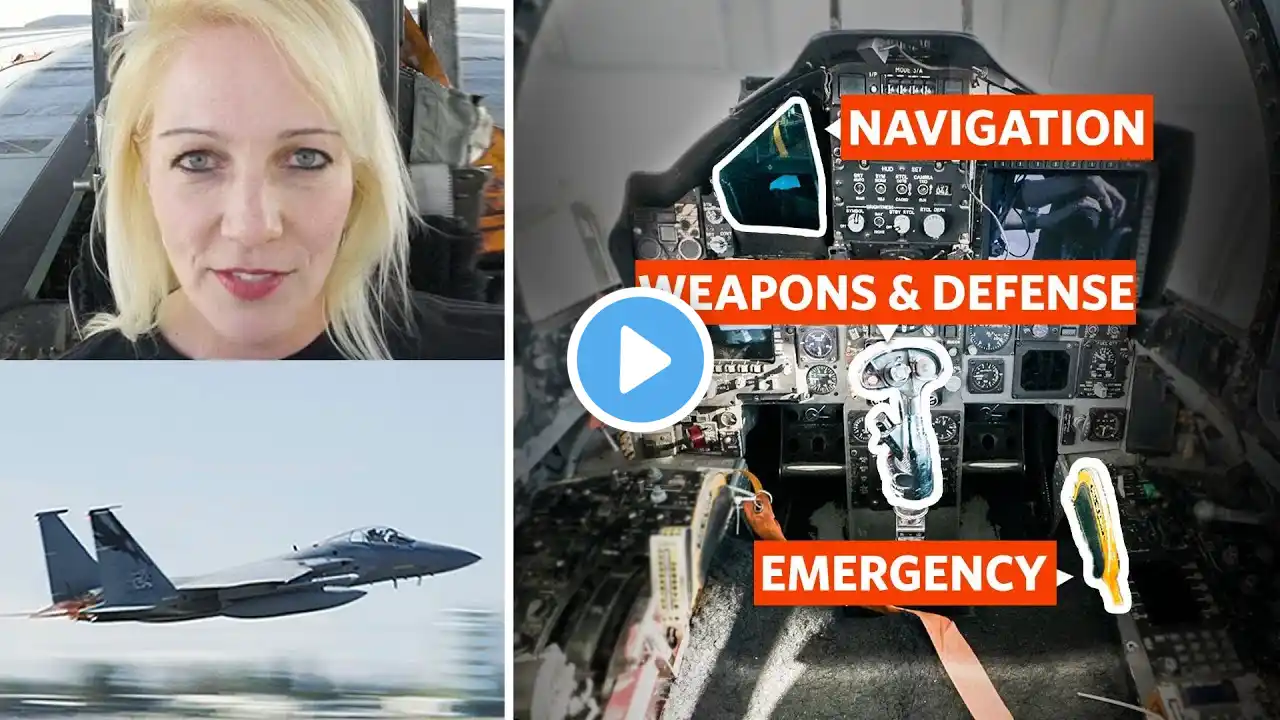
The Dark Reason America Shredded Every Retired F-14 Tomcat
September 1980. An Iraqi MiG-21 pilot crosses into Iranian airspace over Khuzestan province and picks up a radar warning he's never seen before. Not the familiar pulse of a Soviet-built system. Something else. A continuous wave signal - the kind that means a missile is already tracking you from 60 miles away. He turns back. He doesn't even know what's shooting at him. How did Iran - cut off from American spare parts, purged of its best-trained officers, in the middle of a revolution that nearly dissolved its entire military - manage to operate the most sophisticated interceptor on the planet? How did a country under total US embargo keep the F-14A Tomcat not just flying but killing at a rate that would make any NATO air force jealous? And why has almost nobody in the West heard the real numbers? The F-14 Tomcat was built to do one thing: fleet defense for the United States Navy. Hughes Aircraft designed the AWG-9 weapons control system to track 24 targets simultaneously and engage six of them at once with AIM-54 Phoenix missiles. Each Phoenix could reach out past 100 nautical miles. No other fighter on earth carried anything close to that capability in 1980. The Soviets knew it. The Iraqis were about to learn it. Iran took delivery of 79 Tomcats between 1976 and 1978 under Shah Mohammad Reza Pahlavi. Grumman technicians were still on the ground when the revolution hit in February 1979. American contractors left the country. Spare parts shipments stopped. The CIA reportedly assumed Iran's Tomcat fleet would be grounded within months - a reasonable bet, given that the Islamic Republic was simultaneously executing or imprisoning dozens of imperial-era pilots and maintenance officers. The AWG-9 alone contained components sourced from over 30 American subcontractors. You can't exactly substitute parts from a Tehran bazaar. But the fleet didn't die. Iranian technicians - many of them trained at Miramar and other US facilities before the revolution - began cannibalizing damaged airframes, reverse-engineering components, fabricating what they couldn't source. The exact number of operational Tomcats at any given point during the Iran-Iraq War remains disputed. Some sources say as few as 15 were combat-ready at the war's peak. Others put it higher. What isn't disputed is the output. Iranian F-14's are credited with approximately 160 air-to-air kills over eight years of war against Iraqi fighters that included MiG-21's, MiG-23's, MiG-25's, Mirage F1's, and Su-22's. Losses in air combat were negligible - perhaps three Tomcats to enemy fighters across the entire conflict. The kill ratio sits somewhere around 50 to one. Iraq's air force had over 700 combat aircraft. Iran's Tomcat fleet, at full strength, never exceeded 80. Khatami Air Base, Isfahan. Summer 1977. The tarmac shimmers at 115 degrees and the air reeks of JP-4 jet fuel mixed with something sweeter - the hydraulic fluid leaking from a freshly delivered F-14A sitting in its hardened shelter. Grumman technical representatives walk the flight line in short sleeves, clipboards out, running post-delivery inspections on aircraft that cost $16 million apiece. The Shah is buying them as fast as Hughes can wire up the avionics. The deal went back to 1973. Nixon and Kissinger had essentially told the Shah he could purchase any conventional weapon in the American inventory - a blank check that no other foreign leader received. The Shah wanted the F-14 specifically because of the Phoenix missile. His air force had been tracking Soviet MiG-25 reconnaissance flights along Iran's northern border, flying at Mach 2.8 above 60000 feet. Nothing else in the Iranian arsenal could touch them. The Tomcat could. Grumman delivered the first aircraft in January 1976. By mid-1978, 79 airframes had arrived along with 284 AIM-54 Phoenix missiles, spare engines, ground support equipment, and roughly 400 American contractor personnel embedded at three Iranian bases. Iranian pilots trained at NAS Miramar and NAS Oceana alongside US Navy crews. Some of them scored higher in weapons employment exercises than their American counterparts. The Imperial Iranian Air Force wasn't a paper tiger. It was arguably the most capable non-NATO air arm on the planet. Then February 1979 erased all of it overnight. The revolution's purge of the military killed or imprisoned an estimated 60 senior pilots. Entire squadrons lost their commanding officers. Maintenance logs - kept in English by Grumman standards - became difficult to interpret as bilingual technicians fled or were removed. The US immediately froze all military shipments. Roughly 80 Phoenix missiles that had already been paid for sat in American warehouses. They never shipped. #coldwar #gulfwar #militaryaviation