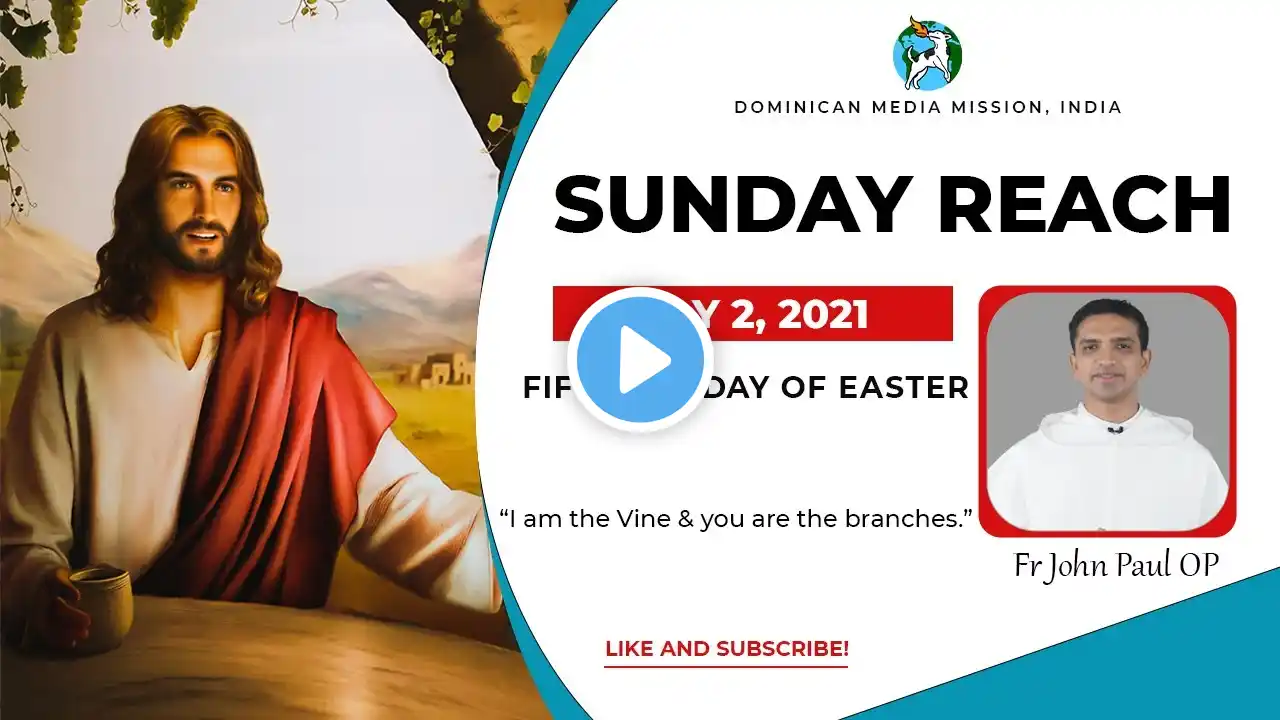
Fifth Sunday of Easter ||May 2, 2021|| Sunday Reach (Fr John Paul OP on John 15:1-8)
On this fifth Sunday of Easter, dear brothers and sisters, the gospel presents us with one of the most beautiful passages in the Scripture. There is hardly any passage in the New Testament that better defines the nature of Christian life. “I am the vine, you are the branches. Those who abide in me and I in them bear much fruit because apart from me you can do nothing.” (Jn 15: 5). Jesus our Master, speaking to the disciples at the last supper, through this analogy of the Vine and the branches, teaches them that Christian discipleship is a mystery of Communion with Jesus. The Christian life becomes fruitful, effective, and meaningful only when we remain united to the person of Christ, like the branches to the Vine. Remember, dear brothers and sisters, on the day of our Baptism, we are grafted on to the Paschal mystery of Jesus, on to the very person of Jesus. Since then, from this Vine, we receive the precious sap that enables us to share in the divine life of the Trinity. And not only that, this divine life that we receive from Christ enables us to live like Christ, to live in Christ, and to love our brothers and sisters just as Jesus did in his life. Hence, as Christians, if we are to bear fruit, it is essential that we remain in the person of Christ. But the question is, how do we abide in Christ? How can we remain in Him, so that we are able to bear abundant fruit? Firstly, we abide in Christ through his life-giving word. In other words, by devoutly reading the word of God, by meditating on the words of Christ, by treasuring his precious words in our hearts, we let Christ remain in us. According to the Scripture, there is an intimate connection between abiding in Christ and abiding in his word: when we fill our minds with the words of Christ, we begin to have the mind of Christ, and with the mind of Christ, we think like Christ and we act like Christ. And that’s precisely why St. John tells us: “All who obey his commandments abide in him, and he abides in them” (1 Jn 3:24). Secondly, we abide in Christ through the meaningful reception of the sacraments, most importantly the sacrament of the Holy Eucharist. Remember, Jesus is comparing himself to a Vine in the context of the last supper, when he celebrated the first Eucharist and explained its meaning and significance to his beloved disciples. If the disciples are to be fruitful in their lives, Jesus says, it is indispensable that they remain in communion with their master. And this union, this intimate communion between the master and the disciples is realized in a unique manner by the worthy reception of his body and blood in the Holy Eucharist. Jesus said: “Those who eat my flesh and drink my blood abide in me, and I in them” (Jn 6:56). Thirdly, we become fruit-bearing Christians, remaining united to Jesus, by allowing ourselves to be pruned by the Father. A caring farmer prunes the branches by cutting off what is not necessary, so that, by not wasting the sap of the vine, the branches become more fruitful. In the same way, the Father prunes our lives, especially, of things that drain the spiritual vitality of a Christian disciple. Very often, we wonder, why, as practicing Christians, we have failed to bear fruit? Why no one is drawn to Christ through our life and witness? Well, we have to be pruned! We have to be pruned of those elements of our lives, like pride, selfishness, lust, anger, unforgiveness and other sinful inclinations which stifle our spiritual life. In fact, they consume so much of our life and energy that we often have very little left for God’s word, prayer and spiritual growth. Once, Michael Angelo, the world-renowned sculptor while walking through a garden in Florence, came across a block of marble covered in filth and mud. Immediately, he stopped as if he had seen someone, and he said to his friends, “an angel is imprisoned in that marble, I must get him out.” Very soon, armed with a chisel, he began to work on that marble and a beautiful figure of an angel appeared. Similarly, the heavenly Father shapes and prunes us. He takes the chisel, which is the cross and begins to work on us, by removing all that is not wanted in our lives. He takes the pruning shears and begins to prune us, by letting us go through trials, tribulations, temptations, and challenges, so that we may be conformed to the image of his own Son and that we may bear abundant fruit. Dear brothers and sisters, each one of us is like a branch that can only live and bear fruit if its union with the Lord is nourished, strengthened, and deepened every day, particularly through the word of God and through the sacraments. And again, the Father prunes us so that we might be able to bear more abundant fruit for the glory of God. And, in fact, that is the whole purpose of the Christian life. For Jesus reminds us: “I chose you and appointed you to bear fruit, fruit that will last” (Jn 15:16). Amen. #dominicanmediamission #DOMINICANFRIARSINDIA