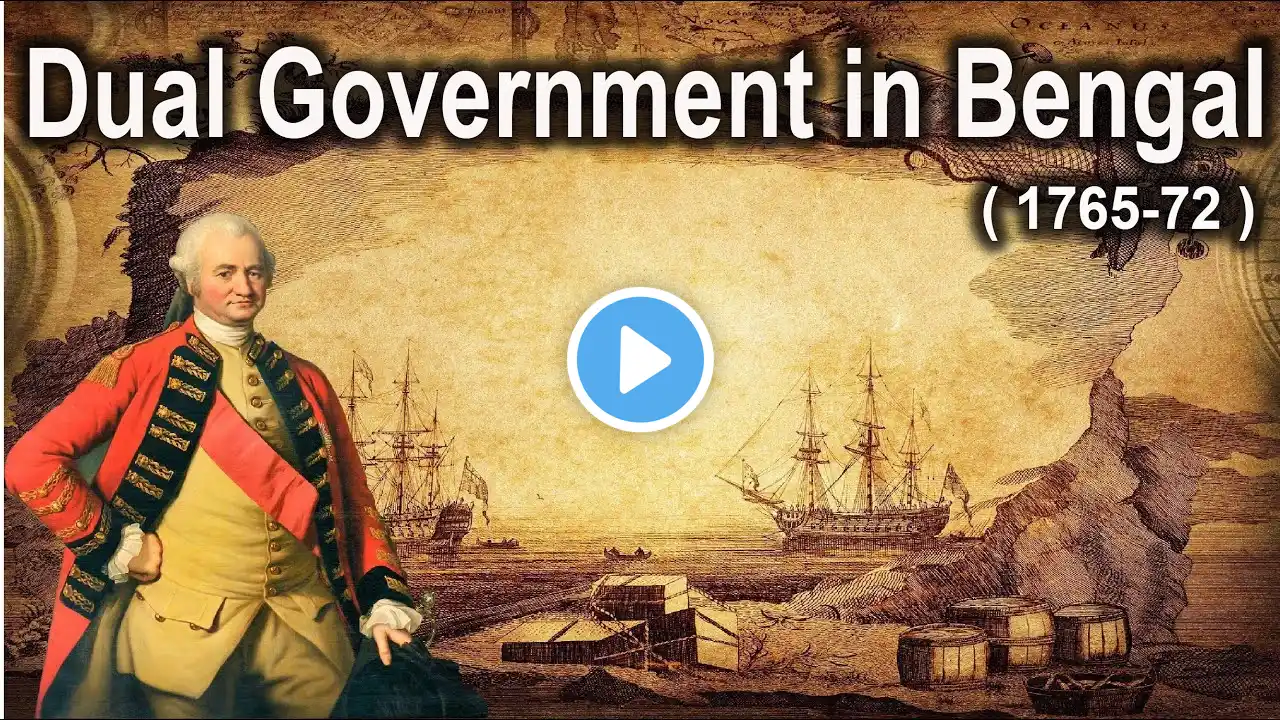
Dual Government in Bengal (1765-72) in Hindi | Spectrum Modern History | East India Company | UPSC
WELCOME TO OUR CHANNEL Dual Government in Bengal (1765-72) in Hindi | Spectrum Modern History | East India Company | UPSC In 1765, the Company got the rights of the Diwan, viz., the rights to collect revenue and dispensation of civil justice for Bengal, Bihar and Orissa from the Mughal emperor. The Nawab of Bengal, however, retained the rights of the Nizamat, viz., the rights to maintain peace and order, defend the frontiers against foreign aggression and dispensation of criminal justice. Thus, the ruling authority of Bengal was divided under two heads. The one head was given under the charge of the Nawab and the other, under the charge of the Company. Because of this division of authority, the rule in Bengal between the period 1765-1772 has been called the “Dual Government”. The “Dual Government” was the result of the Company’s refusal to take the direct responsibility of administering Bengal. The “Dual Government” failed completely. During its period the abuses of private trade by the servants of the Company reached a climax. The privilege of dastaks was so misused that the Indian merchants failed to compete with the English and were completely ruined. Indian industries were also ruined. The Company used its political power to ruin the silk industry in Bengal. The cotton cloth industry which was the most developed one in Bengal was also ruined. The representatives of the Company arbitrarily decided the quality of the cloth, its quantity of production and its price much against the interest of the artisans. If any artisan or worker protested, he was severely punished or tortured. Therefore, many of them changed their profession and many others left Bengal. Agriculture was also destroyed because of the excesses of the Company. Land was assigned to the highest bidder every year for the collection of revenue. These bidders or the farmers of taxes collected maximum revenue from the farmers to draw maximum gain for themselves within a year. The Company increased its demand every year from the contractors. The contractors, in turn, increased their demand from the farmers while they were no way interested in increasing the production. Therefore, the peasants were the worst sufferers and many among them left their lands and became dacoits and robbers. Ultimately, the income of the Company also suffered. It could get neither good revenue nor enjoyed better trade. Therefore, it felt the necessity of bringing some reforms. In 1769, the Company divided Bengal into thirty districts and appointed one English Supervisor in each district. But the measure yielded no fruitful result. The supervisors were appointed with the sole purpose of getting maximum revenues for the Company. They were not required to look after the welfare of the peasantry, to provide justice to them, to help them to increase production or even to supervise the working of Indian revenue collectors. Besides, the supervisors were permitted to engage in private trade which became their primary concern. Therefore, the experiment of appointing supervisors failed miserably. In the same way, the experiment of appointing revenue councils in 1770 also came to naught. Conclusion Thus, the Dual Government in Bengal failed miserably. It destroyed the trade, industry and agriculture of Bengal. In 1770, Bengal suffered from a severe famine and nearly one-third population of Bengal fell victim to its ravages. Though, of course, it was primarily because of the failure of rains, there is no doubt that the sufferings of the people had increased manifold because of the misgovernance of Bengal under the system of “Dual Government”. The Company also did not remain unaffected by the evils of its administration. Its income both from revenue and trade suffered. The practice of private trade which remained the primary concern of its servants, also proved disastrous to the fortunes of the Company. Thus, the Dual Government in Bengal failed ignominiously. #Battleofplassey #BengalDivision #BritishGovernment INSTAGRAM: / tejas_dhaka1000