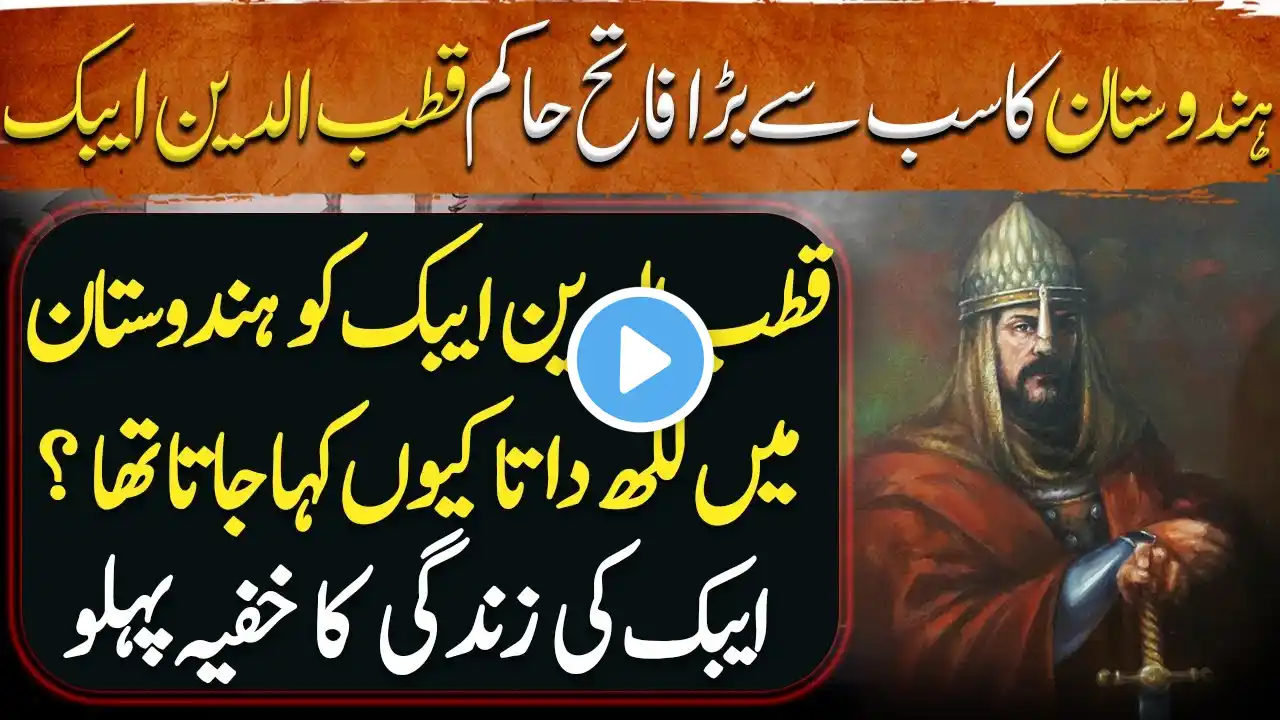
Sultan Aibak Ep05 | Conquest of Delhi and Aligarh by Qutb-ud-din Aybak
Aibak stayed in Ghazni for about six months. After his return to India in 1194, he crossed the Yamuna River, and captured Koil (modern Aligarh) from the Dor Rajputs. Meanwhile, taking advantage of Aibak's absence in India, Hariraja had regained control of a part of the former Chahamana territory. After his return to Delhi, Aibak sent an army against Hariraja, who committed suicide when faced with certain defeat. Aibak subsequently placed Ajmer under a Muslim governor and moved Govindaraja to Ranthambore. Who was Qutub-ud-din-Aibak? He was the first sultan of Delhi. Against their fortifications, he mounted juggernauts in 1195–1203, while his assistant Bakhtiyr Khalj conquered Bihar and Bengal. The Qazi treated him with honour and helped him with a solid education, including weapons and riding lessons as a kid. After his lord’s death, Aibak was sold to a slave trader. Sultan Muhammad Ghori, the king of central Afghanistan, bought him. Qutubuddin Aibak paved his path to General and soon became his most trusted noble. Qutb ud-din Aibak was behind the conquering of northern India, which aided Ghori in consolidating his authority there. Sultan Ghori was gradually handed independent leadership of the conquests in India as he focussed on Central Asia after 1192. He married the daughter of Tj al-Dn Yildiz of Ghazna, one of the two main aspirants to replace Muizz al-Dn, and reinforced his reign by other skillfully arranged marriages. Iltutmish (reigned 1211–36), his son-in-law, ablest general, and successor, was able to secure the independence of the Delhi sultanate by resting his power on the victories of Qutb. Reign of Qutub-ud-din-Aibak He was the first sultan of Delhi. Qutb-ud-din Aibak fought endlessly to conquer northern India and helped Ghori press his dominance there. Sultan Ghori got handed independent leadership of the conquests in India as he focussed on Central Asia after 1192. Qutub-ud-din was also given a part, but he shared it among his colleagues and enslaved people. When Ghori learned of this, he inquired of Aibak as to why. Aibak said that his Majesty’s largesse covered all of his needs, and he had no wish to burden himself with extras as long as he maintained his sovereign’s favour. The Sultan was so delighted with his response that he immediately nominated him to an exalted position in the court, and subsequently, he was named Master of the Horse (Lord of the Stables). Campaigns of Qutub-ud-din- Aibak After being killed, Qutb al-Dn was Muizz al-logical Dn’s successor (1206). He was still officially enslaved, but he was granted manumission soon. Except for one daughter, Muhammad Ghori had no offspring. As a result, he delighted in buying Turkish slaves and teaching them. “Other rulers may have one or two sons: I have thousands of sons, namely my Turk slaves who will be the successors of my dominions and who, after me, will take care to perpetuate my name in the Khutbah across those areas,” he once declared. Ghiyth, the senior Ghurid commander and suzerain, and Muizz al-Dn, his brother and devoted servant, pushed Ghurid’s authority to its pinnacle between 1173 and 1202. Meanwhile, Muizz al-Dn and his lieutenant, Qutb al-Din Aibak, were extending Ghurid control over northern India, from the Sindhi city of Multn to the Bengali city of Gaur. Qutub-ud-din was the most notable of them all for his bravery and generosity. Ghori had paid a great price for him from some Ghazni merchants. He was given the name Aibak because his little finger was fractured. Ghori lavished lavish gifts on his followers and staff during a court event. Qutub-ud-din was given a part as well, but he split it. Legacy and death of Qutub-ud-din-Aibak Qutb-ud-din Aibak met death in an accident in a polo game in 1210. He got hurt when he fell from his horse. He was brought to rest in the Anarkali Bazar in Lahore. Iltutmish, another enslaved person who attained the rank of Sultan. Qutb-ud-din Aibak began work on the Quwwat-ul-Islam mosque and the Qutub Minar, two of Delhi’s earliest Muslim landmarks, but he could not finish them. This mosque was constructed by deconstructing Prithvi Raj’s Hindu temple, with portions of the temple remaining outside the mosque. Iltutmish, his successor, built these structures later. Conclusion Qutub-ud-din-Aibak (1150-1210) was a general in the reign of Ghurid King, Muhammad Ghori. Aibak acquired the throne of Delhi after the death of his predecessor Muhammad Ghori and gave rise to the Delhi Sultanate. He is associated with my battles and was a prized warrior. Born in slavery, Aibak was sold out to Muhammad Ghori in Ghazni and developed skills to pave his path as a warrior. This article shed light on the life of Qutub-ud-din-Aibak and his legacy in Indian historical evidence. #SultanAibak #Qutbuddinaibak #sultanghori