Question 4, AP Calculus BC 2018 Test
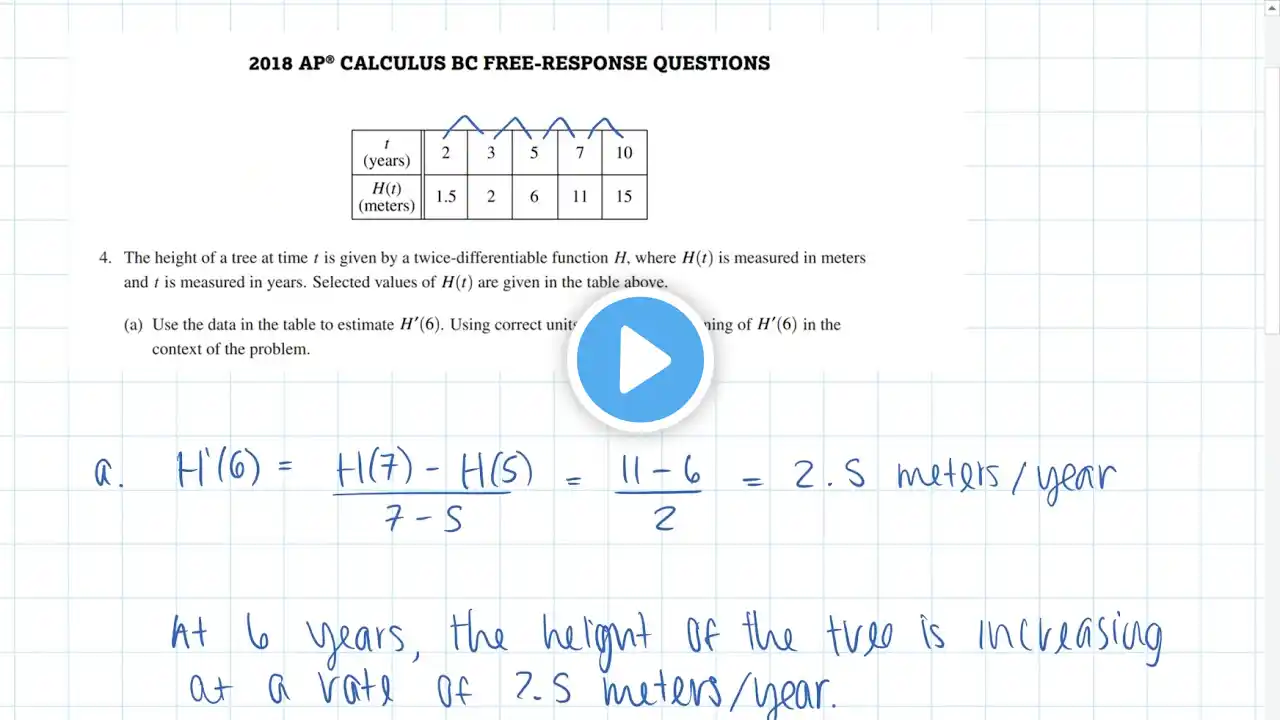
The height of a tree at time t is given by a differentiable function h(t). We need to estimate h'(6) using the data provided. To do this, we use the values from the table for t=5, 6, and 7. Subtracting the heights at t=5 and t=7, we get 11-6=5. Dividing by the difference in time, 7-5=2, we find h'(6) ≈ 5/2 = 2.5 meters per year. Next, we need to explain why there exists a time t between 2 and 10 where h'(t)=2. Since h(t) is differentiable and continuous, we can use the Mean Value Theorem (MVT). Using the values at t=3 and t=5, we find (6-2)/(5-3) = 4/2 = 2, proving that h'(t)=2 for some t between 2 and 10. For the last part, we use a trapezoidal sum to approximate the average height of the tree between t=2 and t=10. We divide the interval length (10-2=8) and compute the sum of the heights at each interval endpoint. After calculations, we find the average height to be approximately 8.219 meters. Now, we move on to another problem involving the height of a tree. The function g(x) = 100x/(1+x) models the height of the tree based on the diameter of its base. We want to find the rate of change of the tree's height with respect to time when the tree is 50 meters tall. To find the corresponding diameter, we set g(x) = 50 and solve for x. After simplification, we get x=1. Then we differentiate g(x) with respect to t using the chain rule. The derivative is given by g'(x) * dx/dt. Since dx/dt = 0.03 (the rate at which the diameter is increasing), we substitute the values and evaluate the expression to find the rate of change of the tree's height to be 0.5 meters per year. These are the solutions to the exercises. Buy a clever and unique math t-shirt: https://rb.gy/rmynnq 4. The height of a tree at time t is given by a twice-differentiable function H, where H(t) is measured in meters and t is measured in years. Selected values of H(t) are given in the table above. (a) Use the data in the table to estimate H'(6). Using correct units, interpret the meaning of H'(6) in the context of the problem. (b)Explain why there must be at least one time t, for 2 less than t less than 10, such that H'(t)=2. (c) Use a trapezoidal sum with four subintervals indicated by the data in the table to approximate the average height of the tree over the time interval 2 less than or equal to t less than or equal to 10. (d) The height of the tree, in meters, can also be modeled by the function G, given by G(x) =100x/(1+x), where x is the diameter of the base of the tree, in meters. When the tree is 50 meters tall, the diameter of the base of the tree is increasing at a rate of 0.03 meter per year. According to this model, what is the rate of change of the height of the tree with respect to time, in meters per year, at the time when the tree is 50 meters tall? Please visit our Merch Stores and help support the spreading of knowledge:) Our T-Shirt Merch: https://my-store-cf0bfb.creator-sprin... Our Amazon Store for Awesome Merch too: https://amzn.to/3OttJgU Amazon Music Free Trial: https://amzn.to/3PzvbzY Amazon Prime Free Trial: https://amzn.to/3PUrmoN Audible Plus Free Trial: https://amzn.to/3RPcrxI Kindle Unlimited Free Trial: https://amzn.to/3yXGZVs Video Game Bestsellers: https://amzn.to/3aZSX9h Are you a fan of our content and want to support us in a tangible way? Why not check out our merchandise? We have a wide range of products, including t-shirts, hoodies, phone cases, stickers, and more, all featuring designs inspired by our brand and message.By purchasing our merchandise, not only will you be showing your support for our work, but you'll also be able to enjoy high-quality, stylish products that you can wear or use in your daily life. And best of all, a portion of the proceeds goes directly towards helping us continue to create and produce the content you love.So what are you waiting for? Head over to our online store now and browse our selection of merchandise. We're sure you'll find something you love.