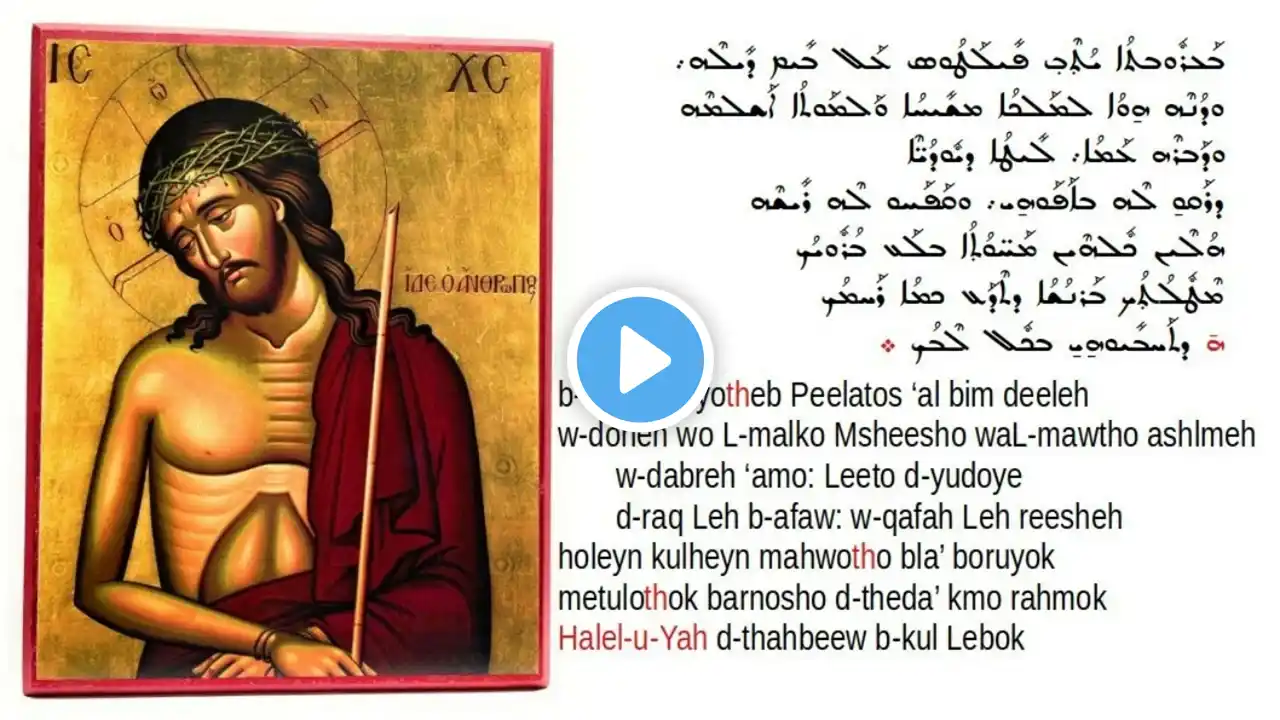
Good Friday - Third Hour - Quqoyo - Why Christ endured all these afflictions ?
The qolo Quqoyo of the Third Hour prayers of Good Friday has 4 stanzas in the Syriac Feqnitho of Hasho. Of these 4 stanzas the 2nd stanza and the 4th stanza are the only ones that appear in the Pampakuda text. These two stanzas are translated as stanzas starting with "ജഗതീ ശില്പി പരാദ്യ സുതൻ വെള്ളിദിനേ മൂന്നാം" and as "സ്ലീബായിൻ തരുവിൻ മീതെ ലോകത്തിൻ പ്രഭായാം" and appears in the Malayalam text. The 1st and 3rd stanzas are missing. In this video I have included the Syriac original and English translation of the first stanza of the 4 stanzas of qolo Quqoyo of the Third Hour prayers of Good Friday. I have no experience setting hymns to a meter. The English translation set to the Syriac meter included with this video is my very first attempt at that. There is a reason why this stanza appealed to me . A question always comes up: "As Christ is God and all powerful, He could have just forgiven us all, ended death and emptied Hades all by one word. Why did Christ have to endure all the passions, crucifixion and death? " Several people have come with several explanations for this. Let us just look at two such explanations: 1) As humans had sinned, they had become slaves or captives of Satan. When bad people kidnaps a child, you have to launch a rescue mission. To rescue a captive, sometimes you have to pay a ransom to the kidnapper. So this theory known as the "Ransom theory" states that the Passion of Christ was indeed the ransom that was paid to rescue humans. 2) Another explanation states that; the sin of humans enraged God the Father and incurred the wrath of God. Christ took the sin of humans in His own flesh and accepted afflictions on his body and shed his blood as a punishment for the sin of humans. In other words Christ took on the punishments as a substitute for humans and by the blood of Christ the wrath of God was quenched. This theory is called the "Penal Substitution Theory". Even though these explanations are based on a very legalistic western mind and is heretical, they have influenced the minds of several members of the Syriac Church as well and blinded us to the true explanation given by the Syriac fathers. These theories have several problems and is heretical. As per this theory even God has to pay a ransom to rescue a captive. That is not our understanding of God. Our understanding is that our God is a sovereign all powerful God and there is no power or authority to whom God has to pay a ransom to get something done. As per this theory God the Father is portrayed as a vengeful God, whose wrath is only satisfied by blood. That is also inconsistent with our understanding of God as a loving God. That is where this hymn in the Quqoyo tune gives us a very clear answer to our original question. Why did Christ endure all these afflictions? Christ endured these passions NEITHER as a ransom paid to Satan NOR as a substitution punishment to appease the wrath of God the father, BUT to show us humans .. how much he loves us. He is telling us, or rather is showing us ..He loves us no matter what. We may sit in judgement and judge Him, we may spit on Him, we may hit Him on his head.. even then He takes it and just returns us nothing but Love. His prayer is: "Father, forgive them, for they don't know what they are doing." . He wanted to demonstrate His unconditional LOVE towards us all .. so that we will also LOVE Him with all our heart. He also taught us thru his disciples : "anyone who does not love his brother, whom he has seen, cannot love God, whom he has not seen". So He wants us to Love Him and to Love each other. I don't know if there is better way to explain it than these lines of the Syriac fathers: holeyn kulheyn mahwotho bla’ boruyok metulothok barnosho d-theda’ kmo rahmok Halel-u-Yah d-thahbeew b-kul Lebok Literally translated as: "Your creator endured these afflictions for you, O Human! to make you know how much He loves you, that you may love Him with all your heart." We can read this same theme in the Bible... in Romans 5:8 "God shows his love for us in that while we were yet sinners Christ died for us."