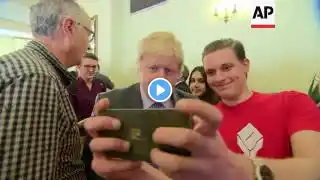
Johnson's support for 'leave' could make him PM
(21 Jun 2016) While still Mayor of London, UK legislator Boris Johnson declared his support for Britain's exit from the European Union and positioned himself in direct opposition to his Conservative Party leader and Prime Minister, David Cameron. With the country's EU membership referendum taking place on Thursday, Johnson is set to find out whether his move, which many consider a play for the leadership, has worked. The safe course for the ambitious former London mayor would have been to back Cameron, a long-time political ally, in his bid to keep Britain inside the 28-member bloc and let the prime minister sink or swim. Instead, Johnson decided to become the most prominent figure in the "Vote Leave" campaign and use his considerable clout to try to pry Britain out of the EU - a result which would mostly likely also push Cameron out. Many observers believe Cameron's days at 10 Downing Street would be numbered if his "remain" team lose the referendum vote. Such a result would make Johnson a strong contender for the leadership role. Long-time Johnson-watchers view his perch at the helm of the "leave" campaign through this Downing Street prism, said Tony Travers, a political scientist at the London School of Economics. "Undoubtedly he has a longer-term ambition, a desire to be leader of his party and therefore prime minister," said Travers, who has tracked Johnson for years. "Now many people at the top of politics have that kind of ambition, (but) few make it that obvious." Johnson denies he's eyeing the keys to 10 Downing Street, and has publicly said that Cameron should stay on even if Britain votes to leave the EU. However, few take this position seriously - Johnson said in February it gave him "heartache" to break with Cameron over "Brexit," then jumped into the campaign with customary gusto. The 52-year-old comes across as an unconventional politician despite having followed a classical political path, moving from elite colleges into journalism, on to Parliament, then City Hall, and finally back to Parliament and a minor Cabinet position. "His detractors and critics often say he is not a serious person, that his approach to politics is humorous and freewheeling and perhaps not as thought through as other people," said Travers. "I'm not sure that's true. I think deep down he is a serious person, with serious objectives." Johnson is not alone on the "leave" campaign stage. UK Independence Party chief Nigel Farage has played a prominent role, despite recently coming under criticism for a provocative poster, and Justice Secretary Michael Gove has been a focal point as well. They lack Johnson's flair for publicity, however. Johnson has become the face of the "Brexit" campaign and, perhaps inevitably, the referendum campaign is seen by some as a Cameron versus Johnson race, with Downing Street as the prize. Johnson's decision to break with Cameron over Brexit marks the first public split between the long-time friends and sometimes rivals. They have known each since university days - the two were famously photographed in formal wear during their days as members of the exclusive Bullingdon Club at Oxford. Throughout his career, Johnson has managed to surmount the sort of gaffes that have brought other politicians down. Some believe this resilience would allow him to keep Downing Street in his long-term sights even if Britain votes to stick with Europe. In his newspaper days, Johnson called Africans "piccaninnies" and referred to people from Papua New Guinea as cannibals. Find out more about AP Archive: http://www.aparchive.com/HowWeWork Twitter: / ap_archive Facebook: / aparchives Instagram: / apnews You can license this story through AP Archive: http://www.aparchive.com/metadata/you...


