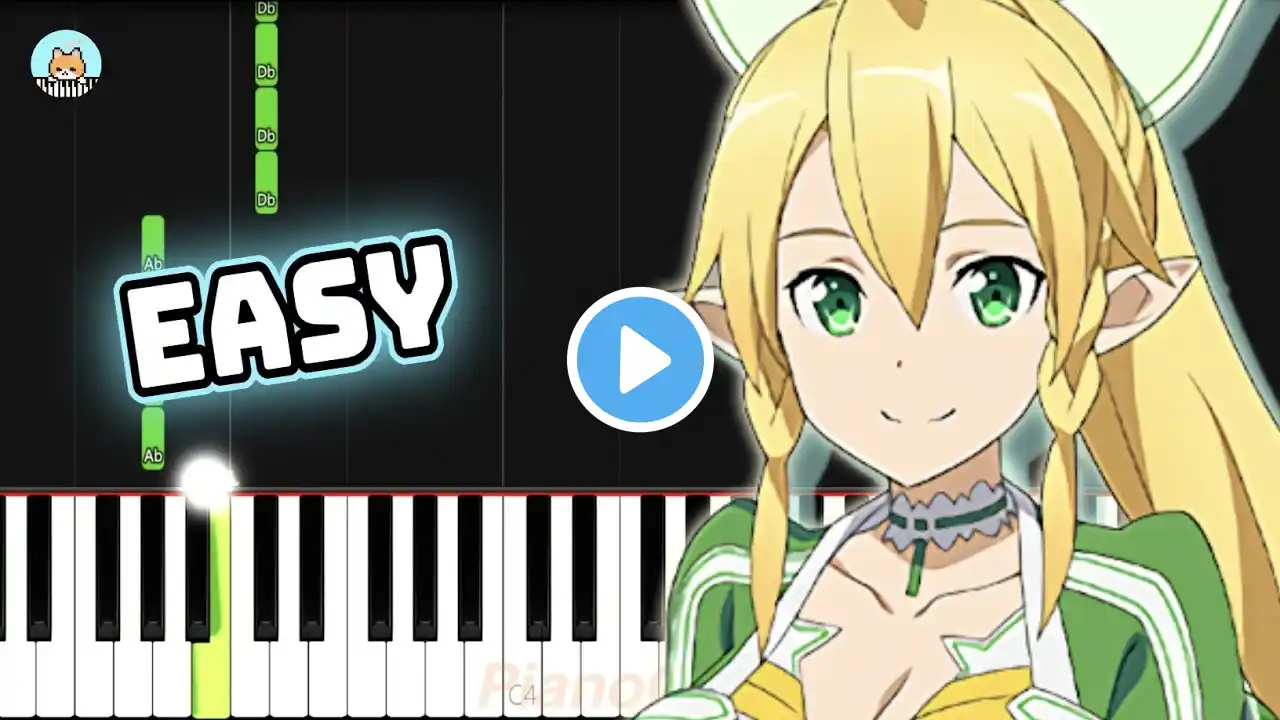
![INNOCENCE (Full Version) - Sword Art Online OP 2 [piano arrangement]](https://krtube.net/image/xpfaxZ2XbqY.webp)
INNOCENCE (Full Version) - Sword Art Online OP 2 [piano arrangement]
#SwordArtOnline #AoiEir #piano Sheet Music https://www.mymusicsheet.com/alexis/5... Recently, due to returning to the United States to begin my new semester and purchasing brand new equipment, I could not upload the new arrangement on time. During this period, I established a mini studio in my dorm, and also purchased the same Nord Grand digital piano as Animenz’s, and also purchased a star projector as a lighting decoration, so as to achieve the best video effect within my power. I hope you like it! The song INNOCENCE means a lot to me. Because of it, I developed a huge enthusiasm for anime music, and further get in touch with anime piano. Sword Art Online and Attack on Titan are the two works that led me to the anime world. Especially Sword Art Online, its music has attracted me deeply when I was still in middle school. Unlike everyone else, many people regard Crossing Field as the most classic SAO OP. But for me, INNOCENCE has a high position in my heart. At the very beginning, LiSA’s Crossing Field did not arouse much interest in me. However, I was deeply affected by Aoi Eir’s powerful singing. Due to my passion for the music of Sword Art Online, I started searching for all piano covers related to Sword Art Online on the internet, and I found Theishter’s version of INNOCENCE (TV Size) and Animenz’s arrangement Swordland. Since then, I have discovered the infinite possibilities of the piano. I have listened to this song back and forth since 2014. I have always wanted to try to arrange it into piano music, but due to lack of skill and experience, I have repeatedly failed. By 2021, after accumulating enough experience in anime piano arrangements, I am finally prepared to give it a try. This arrangement can be regarded as one of the hardest ones I have created. I personally feel that the difficulty exceeds my Kaibutsu arrangement uploaded in May. The most notable feature of this song is its strong drumbeats, intense rhythm, and complicated bridge section. Therefore, this arrangement is mainly based on imitating the original song, without adding too much personal stuff. From the beginning [0:00] to the end of the first chorus [1:36], I strictly followed the original song, trying to create a strong sense of rhythm. Starting from the second verse [1:47], I started to utilize the three-hand technique. Since the original background music contains a lot of practical reference materials, many three-hand sections do not need to be created by myself. Instead, I directly incorporate some of the highlights of the background music into the arrangement. In this part, because of trying to make a difference from the previous part, I used LH arpeggios. At [1:59], I used a brand-new three-hand technique: referring to the original song, I played the descending scale as the ornament with my right hand and re-used the techniques used in my arrangement of Kokokara, Kokokara with my left hand. I played the bass note and the melody at the same time, without losing the sense of rhythm. The Bridge part can be regarded as the most difficult part of this arrangement. This part of the original song is composed of various instruments and the structure is extremely complicated. And, in the original song, here [2:46] If you listen with headphones, there is an electric guitar ostinato with the left and right channels repeatedly switched, that is, G# BG# BC# and G# G# B# G# F# F# G#, the former appears in the right headphone, followed by the latter in the left headphone, which sounded very impressive. In order to restore this highlight, I chose to use the high and low range to distinguish "right part" and "left part". [2:52] Here, the piano ostinato is introduced. Immediately after [2:55], I gave up the last repetition of the electric guitar ostinato, and instead imitated the excellent bassline in the original song as a connection to the next part. Moving on to the next part [2:57], I once again used the technique in the Kaibutsu adaptation, playing strong chords with the right hand as the three-hand technique, and playing the bass note and melody with the left hand. Immediately after [3:03], the melody of the left hand switched to the right hand, creating a sense of richness again. At [3:23], I used rich chords to restore the chromatic gradation of the original string instrument part and then gave it a sudden stop. When it came to the last chorus [3:44], I wanted to give the listeners some rest time as usual, so I created a delicate variation here and brought some different atmosphere. Finally, I used the glissando to enter the final repetition of the chorus [4:08]. Here [4:15], I make some adjustments to the melody, so as to reach the emotional climax of the whole song. Entering the finale [4:41], I followed the voicing techniques that have appeared in my No, Thank You! Kaibutsu, and Kokokara,kokokara arrangements. After that, the piece is ended with a powerful C sharp major chord. Thanks for listening, see you in the next video!