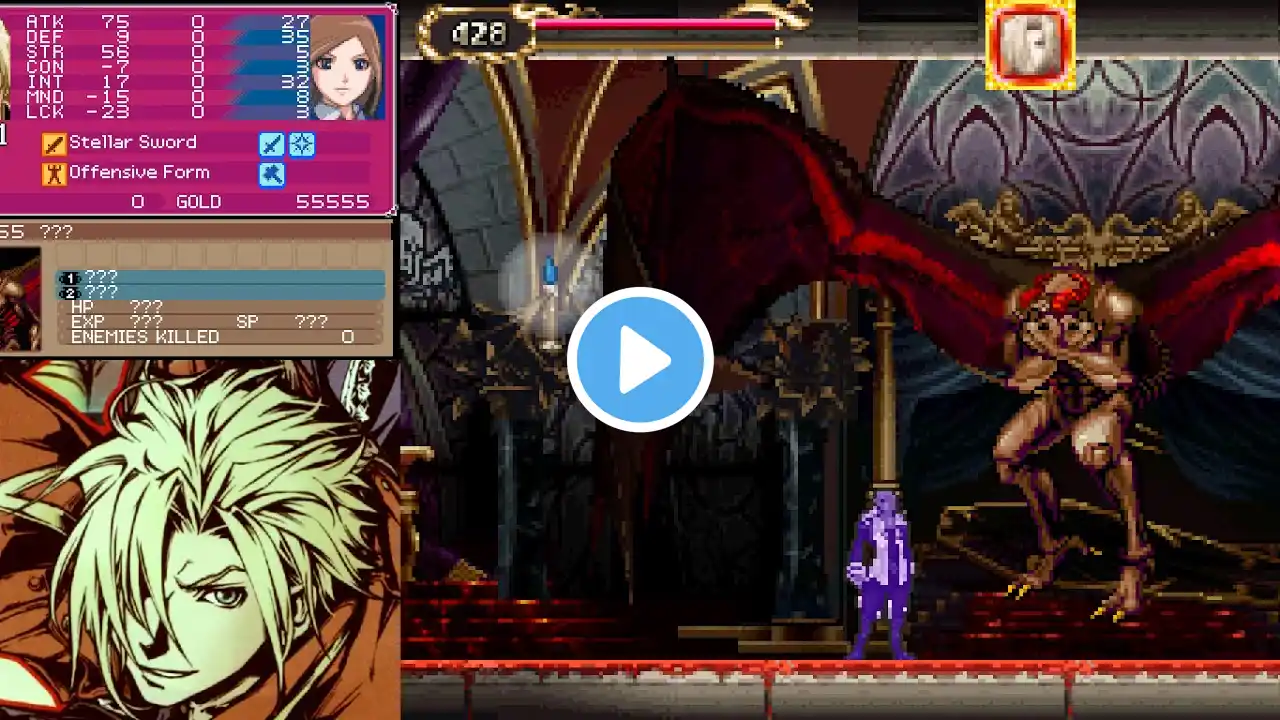
Castlevania: Portrait of Ruin Deathless (Jonathan, Normal)
So much to say - Portrait of Ruin is a game of many extremes. Vicious boss fights, lots of talking, a few excellent systems, a few terrible ones, some highlights, some lowlights. Firstly, let me explain the title of the video. One of the central mechanics of Portrait of Ruin is the ability to switch between two playable characters, Jonathan and Charlotte. In this run, I only directly control Jonathan. Charlotte casts a few backline spells and I use a couple of Dual Crushes, but otherwise this is just the Jonathan show. I'll be posting two Jonathan runs, one on a fresh file on Normal (this video) and one on Hard Mode max Lv1 on a New Game+. I'll also be posting two more videos on the same difficulties, except playing as Charlotte instead of Jonathan. Jonathan uses Sub-Weapons (of which he has a vast array, available at different points in the game) and a whip, like a classic CV protagonist. The moment-to-moment gameplay and combat of Portrait of Ruin is excellent (especially with Jonathan), but its central systems leave something to be desired. While the disastrous Weapon Synthesis concept from Dawn of Sorrow has rightfully bit the dust, Portrait of Ruin introduces "Mastery" system, whereby Jonthan's sub-weapons get stronger the more he uses them, accumulating "skill points" in that particular sub-weapon the more enemies he defeats with it. When these skill points cap out, the weapon becomes "Mastered" and transforms into a stronger version of itself. The Mastery system introduces two problems: for one, it can incentivize grinding for skill points; and for another (more pertinently) it means that situational usage of different sub-weapons is somewhat discouraged. For example, through most of the playthrough I only use the Shuriken sub-weapon (which fortunately has a very low Mastery cap meaning it will be Mastered before I encounter any serious challenges), but there are a few spots in the late-game where I want to use the Bible. However, the Bible is not as good in general usage as the Shuriken is, meaning if I want the Bible to be stronger for the endgame I would need to either use it in situations where it isn't good (not fun) or simply accept a weakened version of it in the endgame (also not fun). Why this system exists at all is mysterious to me, but fortunately, the power of the Shuriken is such that it never becomes an issue. Portrait's second questionable system are the Quests. An NPC in the castle will occasionally send you out to do something in other parts of the game. These quests often necessitate either backtracking, farming for specific item drops, or both. Normally, I'd be happy to ignore this system entirely, but you have to engage with it to unlock the Nest of Evil, an optional but very interesting endgame zone. Unfortunate, but compared to the busywork in a fresh Dawn of Sorrow (or Circle of the Moon, for that matter) file, it's merciful. Story-wise, Portrait of Ruin is more expansive and ambitious than previous entries. Unlike Aria/Dawn of Sorrow, which essentially created their own pocket universe in the franchise full of pointless characters, PoR tries to anchor itself more firmly to the existing Castlevania timeline, serving as a surprisingly direct sequel to the very odd Castlevania: Bloodlines. While PoR does insist on tying itself to some of the less savory elements of the Sorrow duology, what's more important is the plot itself, which attempts to tell an emotional story about history, family, and loss with a much tighter cast. Unlike Aria/Dawn, no character in PoR feels useless. And, most extraordinarily, I actually almost felt an emotion at the end. As is becoming standard for Igavanias, the soundtrack in PoR is inconsistent, with highlights often coming from remixes of older Classic-era songs and all the newer material being low-energy and generally unremarkable. A strong exception is the Entrance music, "Invitation of a Crazed Moon", which is one of the best songs in the series. Overall, PoR is an improvement over Dawn of Sorrow in many ways, but has several flaws that prevent it from rising to the level of Harmony of Dissonance. I'd rank it roughly on par with Aria, or maybe slightly below.Done on emulator, DeSmuME.