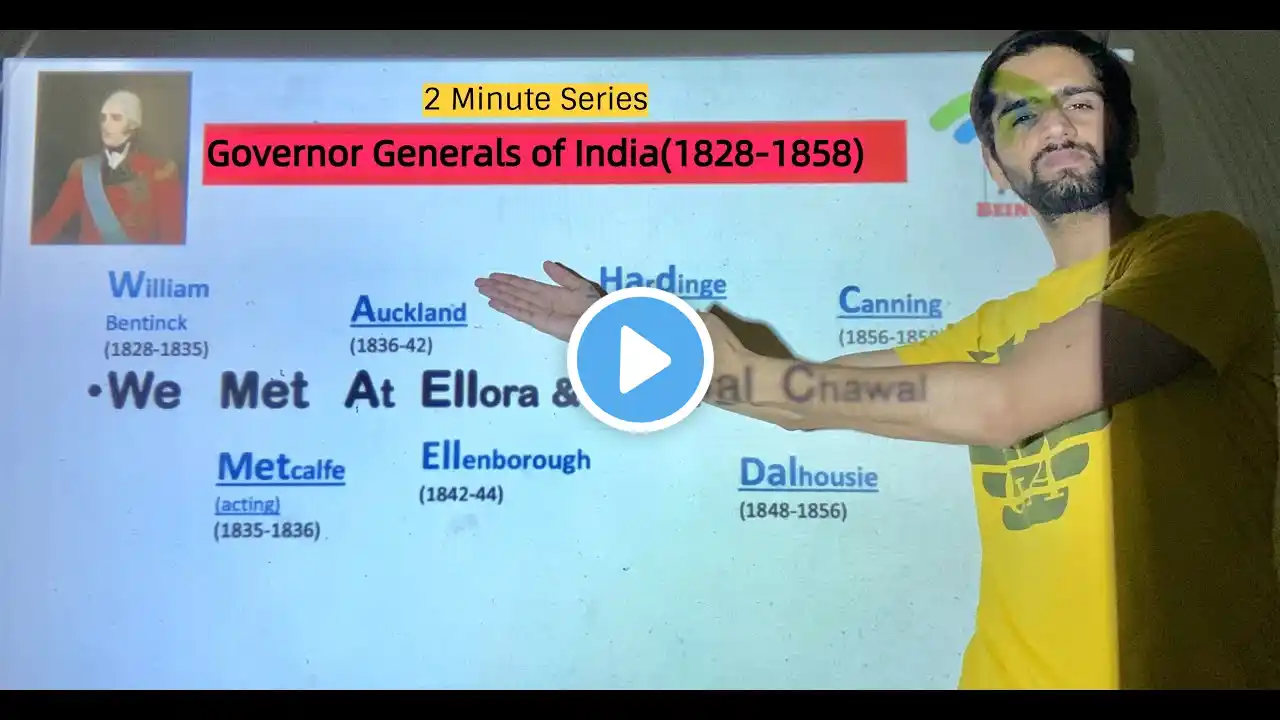
HOW TO REMEMBER GOVERNOR GENERALS WITH MNEMONICS
Modern History with Mnemonics Warren Hastings (1772-1785) End of the dual systems; shifting of treasury Murshidabad to Calcutta. Revenue reforms revenue was taken over by Company. Judicial reforms Zamindars given judicial powers; establishment of civil & criminal courts in each district. Social reforms founded the Calcutta Madrasa Impeachment Warren Hastings tendered his resignation in protest against the Pits India Bill in 1785. John Macpherson, (1785-1786) He held the post temporariily. John Macpherson Lord Cornwallis (1786-1793) Permanent settlement of Bengal land was given on permanent basis to the zamindar instead of giving it to the highest bidder each year. This system got prosperity to both the Company and zamindar had the cost of the common peasantry. Judicial reforms Reorganisation of revenue courts; reorganisation of the criminal courts; depriving Collectors of the judicial functions; compilation of the Cornwallis Code. Police reforms Depriving zamindar of their police functions; establishment of the thanas Sir John Shore (1793-1798) He followed a policy of non-intervention. Sir Alured Clark (1798) He held the post temporarily. Lord Wellesley, (1798-1805) Subsidiary Alliance system . He opened college to train the Company's servants in Calcutta. Lord Cornwallis (1805) Pointed for another term, however died very soon. George Barlow (1805-1807) Mutiny of Vellore in 1806 in which the Indian soldiers killed many English officials. Lord Minto I (1807-1813) treaty with Shah of Persia and Treaty of Amritsar with Ranjit Singh. sENT Sir Charles Metcalfe to the court of Ranjit Singh. Marquess of Hasting (1813-1823) . The first vernacular newspaper Samahar Patrika begin to be published during his time. John Adam (1823) held the post temporarily. Lord Amherst (1823-1828) known for the first Anglo Burmese War (1824-26) and mutiny of Barrackpur (1824). William Bayley (1818) held the post temporarily. Lord William Bentinck (1828-1833) Abolition of provincial courts of appeal and circuit, power of the magistrate increased, appointment of Indians as judges, introduction of the residuary system, Codification of Laws. English accepted as the medium of instruction after the famous Macaulay's recommendation; Medical college at Calcutta in 1835. Abolition of sati in 1829. Suppression of thugee banning of female infanticide; human sacrifice; reform in the Hindu Law of Inheritance. Sir Charles Metcalfe (1835-36) removed the restriction on the vernacular press. Lord Auckland (1836-42) outbreak of first Afghan WAR signing of a Tripartite Treaty among the English, Ranjit Singh and Shah Shuja of Afghanistan. Lord Ellenborough (1842-1844) first Afghan war, annexation of Sindh to the British Empire (1843). William Wilberforce Bird (1844) held the post temporarily. Lord Hardinge (1844-1848) First Sikh War (1845-1846). Lord Dalhousie (1848-1856) youngest to hold the office of the Governor General. famous for the the Doctrine of Lapse .. The second Anglo Sikh War and did Sikh power and Punjab was annexed. Separate Lieutenant Governor appointed for Bengal; Shimla the summer capital. Arillery Headquarters moved from Calcutta to Merrut; headquarters shifted to Shimla; formed Gurkha regiments. First railway line from Bombay to Thana, in 1853. Reforming the defects of the Postal System and linking all the important towns. setting up of universities in Calcutta, Bombay and Madras. In 1853, competitive examination for the Indian Civil Services Lord Canning (1856-1858) Annexation of Avadh; Hindu Widow Remarriage Bill, 1857; universities at Calcutta, Madras and Bombay; the revolt of 1857 Subscribe to channel for more such videos Facebook Page https://www.facebook.com/FREESTUDYCIR...