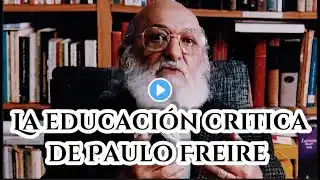
Paulo Freire’s Pedagogy of the Oppressed: Why Education Is Never Neutral ?
What if education is not simply about transferring knowledge but about power, consciousness, and liberation? In Pedagogy of the Oppressed, Brazilian educator and philosopher Paulo Freire develops a radical philosophy of education that asks a fundamental question: Does education reproduce the world as it is, or can it help us transform the world? In this episode, we explore Freire’s central arguments, including: Humanization and dehumanization The internalization of the oppressor The fear of freedom False generosity and paternalistic charity Praxis — reflection and action The banking model of education Problem-posing education The teacher–student relationship Dialogue and the “true word” Conscientização and critical consciousness Generative themes and limit-situations Antidialogical action: conquest, divide and rule, manipulation, and cultural invasion Dialogical action: cooperation, unity, organization, and cultural synthesis Freire's central challenge is deceptively simple: Are we educating people to adapt to the world—or to question and transform it? For Freire, liberation is not something given to the oppressed by an enlightened teacher, leader, or institution. It emerges through critical consciousness, dialogue, collective action, and praxis. This is an extended explanation of one of the most influential works in critical pedagogy and political thought. Book: Pedagogy of the Oppressed Author: Paulo Freire Series: Book Explainer | Pol Science If you enjoy political theory, philosophy, sociology, critical theory, and serious book explainers, subscribe to Pol Science. #PauloFreire #PedagogyOfTheOppressed #CriticalPedagogy #Education #PoliticalTheory #Philosophy #PolScience #Conscientization #Praxis #Liberation